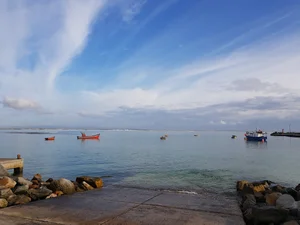
Struisbaai Harbour: What to See and Do at the Heart of the Village
Most people who come to Struisbaai are here for the beach, the lighthouse at Cape Agulhas, or the whales offshore between May and December. The harbour gets driven past on the way to all three. That's a shame, because it's one of the few spots in the southern Overberg where you can watch an actual working fishing village go about its day, for free, in under an hour.
October happens to be a good month to pay it some attention. It's National Marine Month in South Africa, a government-backed awareness month running the full 1st to 31st, built around getting people to notice the coast and ocean a bit more than usual. Struisbaai's harbour is as good a place as any to do that.
A Working Harbour, Not a Postcard
Struisbaai harbour was built in 1959 and it still does exactly what it was built for. Line-fishing boats go out early and come back through the morning with the day's catch, and in the summer holiday season the harbour also fills up with visiting ski boats. There's no entry fee and no set hours for looking, you simply walk down to the water and watch the boats work.
Right at the harbour, Harbour Cafe sits where you can watch locals buy their fish straight off the boats before it even reaches a shop shelf. If you're self-catering (more on that below), this is where you'll find the freshest linefish in town.
Is Struisbaai harbour worth visiting if you're not fishing?
Yes. You don't need a rod or a boat ticket to get something out of it. The appeal is watching a working harbour function the way it has for decades: boats coming in, catch being sold, gulls working the jetty, and one particular local who tends to steal the show (see below). Give it twenty to thirty minutes.
Parrie, the Harbour's Best-Known Resident
Struisbaai harbour has a minor local celebrity: a stingray known to regulars as Parrie, who often glides into the shallow water near the harbour steps to greet whoever's standing there. Parrie isn't fed on a schedule or performing on cue, it's simply a wild animal that has grown used to people at this particular spot, and locals and visitors both tend to stop and watch when it shows up. Keep your hands to yourself and enjoy it from a respectful distance; it's a wild ray, not a pet.
Older Stories, Set in the Rocks
Along this stretch of coast you'll also find old stone fish traps built into the rocks by the Khoi, well before the harbour or the lighthouse existed. They were built to catch fish on the retreating tide and some are still visible today. It's a reminder that people have been reading this coastline and working it for food for far longer than Struisbaai has been a holiday town, and it's the kind of detail that rarely makes it into a quick online search.
What else is there to see near Struisbaai harbour?
A short drive along the coast brings you to a rusting Japanese trawler, the Meisho Maru, wrecked on the rocks and now a well-known photo stop; several local operators run coastal safaris that take in the wreck, the old fish traps and the chance of spotting an African black oystercatcher along the way. From there it's a few minutes more to the Cape Agulhas Lighthouse itself, built in 1848, South Africa's second-oldest working lighthouse and home to the country's only dedicated Lighthouse Museum. If you have a full morning, Hotagterklip, a short way along, is a small former fishing settlement of whitewashed cottages that have been declared national monuments, worth a slow fifteen-minute wander.
When to Go
Mornings are the best time to catch the fleet coming in and the harbour at its most active; by mid-afternoon on a quiet day there's less happening. The walk from the parking area to the water is flat and easy, suitable for most ages and mobility levels, and there's no cost involved beyond whatever you choose to buy. Bring a hat and something to drink if you're going in the middle of the day; there's limited shade right at the water's edge.
Fresh Catch, Five Minutes From the Kitchen
This is where staying self-catering in Struisbaai actually pays off. Land's Edge's cottages and apartments are about 700 metres from the harbour and the beach, an easy walk, which means you can buy linefish straight off the boats or from Harbour Cafe in the morning and have it in your own kitchenette by lunch. Every unit has a kitchenette with a stove-top, fridge and basic cookware, so there's no need to book a restaurant table around it; you cook it the way you like it, on your own schedule.
It's a small thing, but it's the kind of local rhythm you only get access to when your host actually knows the place, rather than managing it from somewhere else. That's also roughly how Land's Edge itself runs: an all-women team, from the owner through to the guest manager and the housekeeping crew, who live locally and know which boats are in, which stall has snoek that week, and what's worth your time beyond the obvious stops.
If you're putting together a longer Struisbaai stay, the harbour is a good one to slot in on a quieter morning between a day at Cape Agulhas and a day further out toward Arniston, De Hoop or the Elim wine route. Have a look at our cottages and apartments and check availability directly with Land's Edge for your dates.