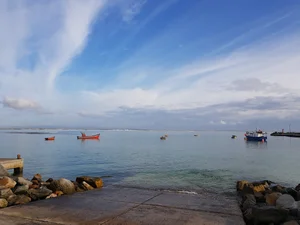
Whale Watching in Struisbaai and Cape Agulhas: A Land-Based Guide
Southern right whales come to this stretch of the southern Cape every year to calve and nurse their young. They start arriving from around June, sightings peak between August and October, and some mothers and calves stay on into November. Unlike Hermanus or Gansbaai, where boat trips are the main draw, Struisbaai and Cape Agulhas offer something better for a relaxed visit: whales you can watch from the beach, on foot, for free.
Peak season, right on your doorstep
Southern rights favour the sheltered bays of the southern Cape, and in peak season the mother-and-calf pairs spend long stretches near the surface, often close to shore. Calm mornings give the most reliable sightings.
What sets this stretch of coast apart from the better-known whale-watching towns further west is that you don't need a boat. The whales come close enough to see clearly from land, so whale watching here costs nothing beyond the time it takes to walk to the water.
Start at Struisbaaiplaat, the beach on your doorstep
Struisbaaiplaat (also called De Plaat) is the long beach that runs along Struisbaai itself, often described locally as one of the longest uninterrupted stretches of beach in the southern hemisphere. Whales have been recorded coming in as close as 20 metres from shore here, which makes it a proper whale-watching spot rather than a consolation prize for travellers who couldn't get a boat trip in Hermanus.
Early morning, before the wind picks up, is the best time to look. Southern rights are slow, surface-heavy whales: watch for a V-shaped blow, a wide black back rolling at the surface, or a tail lifting clear of the water. Bring binoculars if you have them, though at 20 metres you often won't need them. Keep your distance and let the whale set the pace; don't try to approach or follow one along the beach.
Can you see whales from the shore in Struisbaai?
Yes. In season, southern right whales regularly come within sight of Struisbaaiplaat and the Cape Agulhas coastline, sometimes as close as 20 metres from shore. No boat, booking or fee is needed to watch from the beach.
Cape Agulhas: lighthouse views and quieter coastline
Cape Agulhas is a short drive from Struisbaai and sits inside Agulhas National Park, whose coastline runs for 56 kilometres past the lighthouse along a mix of boardwalks and rocky shore. The lighthouse gives you an elevated view over the water, and because this coast sees far fewer visitors than Walker Bay, you get whale watching without the crowds that build up around Hermanus in peak season.
The national park charges a daily conservation fee; check the current rates on the SANParks Agulhas National Park page before you go, as tariffs are reviewed every year. To turn the visit into a proper walk, combine a whale-watching stop with the Rasperpunt hiking trail through the park.
De Hoop Nature Reserve: the day trip worth the drive
De Hoop is about 78 kilometres from Struisbaai: through Bredasdorp, then along the R319 towards Swellendam before turning onto a gravel road for the final stretch to the Potberg gate. Budget around an hour and a half each way, more if you take the gravel slowly.
It's worth the drive. De Hoop is regularly ranked among the largest whale nurseries in the world, and its coastal trail includes Koppie Alleen, a well-known viewpoint for land-based whale watching. If you want to walk rather than view from one spot, the reserve also has the 6-kilometre circular Klipspringer Trail and a boardwalk section of the Coastal Trail that's passable at low tide.
Day visitors pay an entry fee and check in at the Potberg gate. Confirm current gate hours, fees and any access promotions on the CapeNature website before you drive out.
A local footnote: Arniston's whale song
Arniston, about 38 kilometres from Struisbaai, has its own bit of local lore: people who've walked the cliffs at night say you can hear whales calling in the water below. We can't verify it as fact, but if you're staying long enough to add an evening walk to your itinerary, it's a good excuse for one.
Practical tips for whale watching
Go out in the morning once the wind has settled rather than at midday, when glare off the water makes spotting harder. Layer up; mornings on this coast are windy even on a clear day. Whale watching from Struisbaaiplaat needs no fee, no booking and often no binoculars, while De Hoop and Cape Agulhas reward a bit more planning. Wherever you're watching from, keep your distance: these are wild animals in a nursery area, not an attraction.
Make Struisbaai your base for whale season
Land's Edge is about 700 metres from the beach and the harbour, so you can be watching whales before breakfast without getting in a car. Self-catering suits this kind of trip: no fixed mealtimes to work around if you want to be on the sand at first light. Our all-women team lives locally and can tell you where the whales have been showing that week. Use one morning for Struisbaaiplaat, an afternoon for the lighthouse and coastline at Cape Agulhas, and set aside a full day for De Hoop. On a quieter morning, the harbour is a short walk away too.
Have a look at our cottages and apartments and check availability directly with Land's Edge for your whale-season stay.